The Theory of Scintillation with Applications in Remote Sensing was published in 2011. This website was established as a forum for discussing the book and its applications, anticipating new insights and refinements of the computational procedures. The book has served its original purpose well. However, computational resources have improved considerably and the implied completeness of the theory needs elaboration. Radio Scintillation History provides an historical context.
In Scintillation Theory Revisited we review an application of Maxwell’s equations that effectively equates a homogeneous operation with the summation of a media-interaction term and the gradient of the electric-field divergence. The Green-function solution to the homogeneous operation can be used to construct a formally exact equation that characterizes the total field. Tractable solutions are necessarily tailored to constrained configurations. In a transparent inhomogeneous medium one can envision exploring the propagation space by following the progression of a directed narrow beam. Ray tracing algorithms identify the unique path such a beam would follow.
Pursuing the concept further, the field in any slice plane can be represented as a spectrum of propagating plane waves. If the plane-wave components are confined to the forward hemisphere just ahead of the beam source, backward propagating field components are negligible. It follows that the field in the decomposition plane completely defines the field ahead of the plane, whereby a forward-marching solution can be constructed. The propagation problem is reduced to constructing operators that will incrementally advance the field in a rectangular coordinate system.
The forward propagation equation (FPE) and the parabolic wave equation (PWE) support the construction of forward-marching solutions. Each plane-wave component propagates independently. Split-step solutions alternate phase-perturbation and free-space propagation. However, problems amenable to such treatment are confined to near line-of-site propagation. Highly refracting media, such as the earth’s ionosphere at low (HF) frequencies, are excluded.
Generating propagators that accommodate a broader range of propagation angles is analytically and computationally challenging. Homogeneous media support propagation of two orthogonal circularly polarized characteristic modes. Each mode has its own refractive index. In the absence of an imposed magnetic field a single scalar propagation equation characterizes the propagation. Scalar media include the earth’s atmosphere. The same propagation phenomena affect acoustic propagation in water and the earth’s crust. Factorization methods, which are formally exact in transversely inhomogeneous media were reviewed.
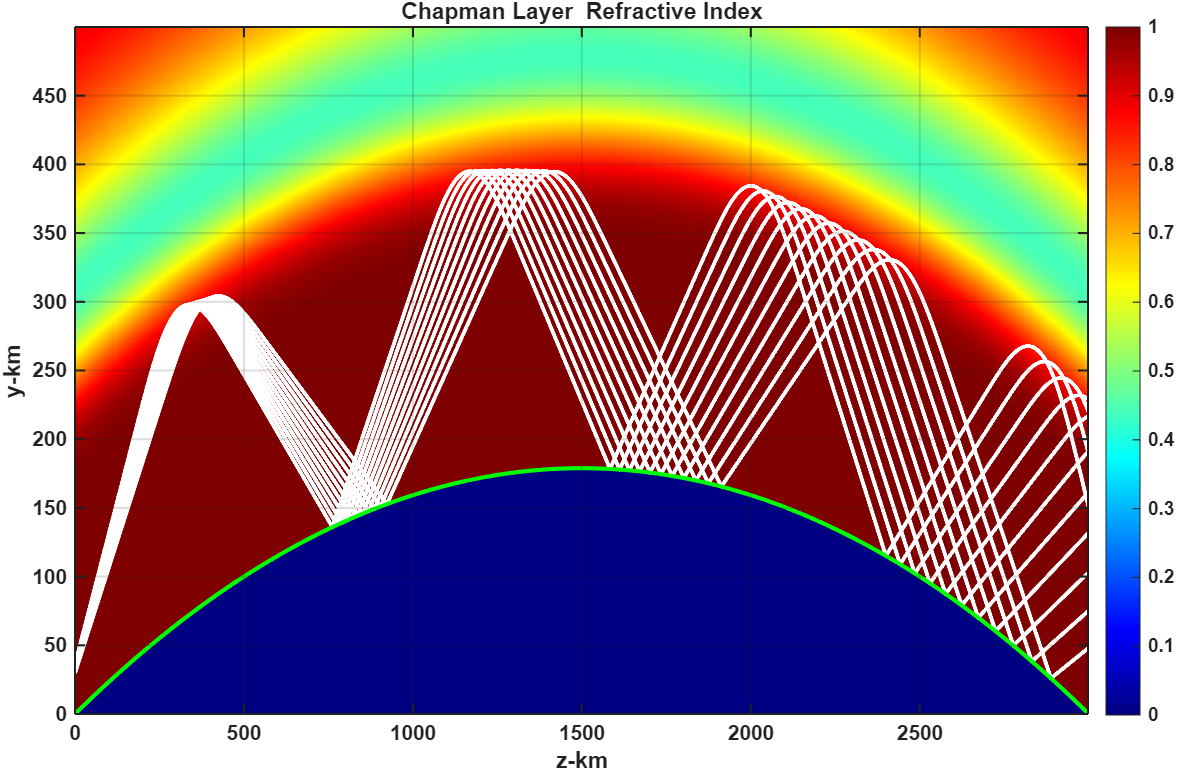
A scalar ray-tracing algorithm was developed as a means of identifying the limits of FPE/PWE simulations. The ray trace algorithm requires only the specification of the refractive index and the gradient of the refractive index. A ray can be launched and traced by specifying the starting position and direction. Rays are terminated at a maximum height and distance. Mirror reflection occurs at a specified lower bounding surface. ChapmanRay is an example.