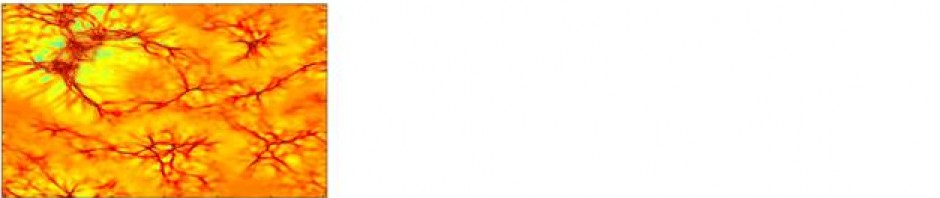
Multiple Phase Screen (MPS) simulations are effectively split-step solutions to the forward propagation equation (FPE). Following the development summarized in Propagation Theory Revisited the FPE is a split-step solution to the time-harmonic scalar wave equation. The split-step solution alternates between an incremental phase perturbation and free propagation over the same distance. The essential points, which are reviewed in Extreme Equatorial Scintillation, are that treating media interaction and free propagation independently is valid theoretically only if the propagating field can be decomposed into a superposition of plane waves with a narrow range of propagation angles. Formally, the factorization of the square-root propagation operator can be approximated by the leading quadratic term is a Taylor series expansion. Using the truncated operator is referred to as the parabolic approximation.
However, we have observed that using MPS with the full-wave propagation operator in a statistically homogeneous medium will ultimately generate complex field structure that spans the full range of propagation angles (-90 to 90 degrees). In effect, an exponentially distributed speckle-like intensity distribution limit is realized irrespective of the initiating incremental phase spectral density function. Strong focusing, indicated by the scintillation index achieving a peak value greater than one still occurs. Theoretical prediction based on the phase-screen theory predict limiting scintillation index values greater than one. If the MPS result is correct it indicates that the MPS theory for simulation supersedes the statistical theory, which is constrained by the parabolic approximation. The conclusion in Extreme Equatorial Scintillation is that complex diagnostic scintillation measures generated by simulation are not constrained by the parabolic approximation.